After a frustrating wait for a Microsoft Band and reading some unflattering reviews on the new (mostly unavailable) device, I started looking around for a fitness band/smartwatch combination. I settled on trying out Garmin’s Vivosmart. I’ve had it now for about a week and so this is my initial review.
For the description of the Vivosmart, click here. I don’t need to duplicate all this descriptive material. Instead, for this review, I want to evaluate the claims and how the device works for me. As they say, your results may vary.
The Vivosmart is a device that comes in two sizes. Most store displays I’ve seen still leave you guessing as to the size of the device that is right for you. I chose the small, and I’m at the larger end of this adjustable band. It is comfortable on my wrist and it’s slim form factor is just the right size for me. It is slightly narrower than a RoadID Slim at just over 1/2 inch wide. The highest part of the band is about 3/8 inches above the wrist. A small rubber “band” is supplied to make sure that the clasp doesn’t come undone and you inadvertently lose this pricy device. That makes the band thicker than most watch bands on your inner wrist.
I chose the simple black band. With the display off (default condition), the screen parameters are barely discernible, making the band look just like a band. A raising of your wrist to glance at the display, or a double tap on the face of the display causes the display to turn on for a brief time (about 8 seconds) unless you interact with the display by swiping through screens. The double tap works more consistently than the wrist raising gesture, for which there is a bit of a lag.
Something not apparent on Garmin’s website is that the display orientation is customizable. It can be set to read left to right (adjustable to which way you tend to wear the device) or vertical (for most of the screens). I chose the vertical display, it seemed more natural for me because I tend to hold it in front of my face as if it is a watch. When my hands are stretched out on the handlebars of a bike, the left to right display might make more sense.
All of the settings for the Vivosmart are made in Garmin Connect. Those can be done either through the web interface or an app on a smartphone. One alarm can be set, for either weekdays or everyday. Mandatory screens include Time and Date & Steps. Optional screens include Step Goal, Move Bar, Calories, Distance, Bike Speed, Heart Rate, VIRB (camera) Remote, Music, and Notifications. More about these below. Default screen can be set. A variety of personal metrics can also be defined.
Some of the screens rely on the device being connected to sensors and other devices.
- Step Goal can be set for a specific goal or automatic adjustment based on past performance. When you reach your step goal for the day, a “GOAL!!” display and vibration notify you of the achievement. It is possible to fool the device about stepping, but why would you do that?
- Move Bar invites you to get up and walk every hour that you are sedentary. The Garmin literature says that if you sit for more than an hour, fat burning enzymes start to diminish in your body. The Vivosmart vibrates if you have not been moving sufficiently for an hour or more. It isn’t annoyingly persistent, reminding you a few times between one and two hours of inactivity and then “giving up on you”. The Movement Bar shows you graphically and digitally how long it has been since you last moved “enough”.
- Calories is estimated based on the personal metrics you’ve inputted and how much you’ve moved.
- Distance is an estimate of how far you’ve walked. There is no GPS on this device. You can include your normal stride length in your personal metrics.
- Bike Speed connects with an ANT+ speed sensor on the bike and the circumference of the wheel you have inputted for your personal metrics. The connection is simple and automatic.
- Heart Rate requires an ANT+ heart rate monitor. Some packages of the Vivosmart include Garmin’s heart rate monitor. I’d personally like to see one on the device itself.
- VIRB Remote requires Garmin’s VIRB camera. I don’t have one.
- Music is a controller for your connected smartphone’s music program. Music can be paused, played, and skipped via the bluetooth connection.
- Notifications has been a very useful function for me in the week I’ve had the Vivosmart. It displays the text message, and the caller id of the incoming phone calls I receive. It will also notify you of incoming emails, but I don’t have those pushed to my phone … I fetch those manually. The Vivosmart signals an incoming text message and phone call before my iPhone notifies me. It is just a fraction of a second faster, even though it is coming through the phone. Rather than pulling out my phone to see who has contacted me, I simply glance at the display on my wrist.
Holding the display for a brief time allows for a secondary level of function screens, including
- Activity timer
- Sleep analysis
- Brightness
- Phone locator
- Synchronization
- Bluetooth On/Off
- Time source
- Battery Status
- Software Version
- And more
The Vivosmart is rated to 5 ATM (50 meters of water depth). Swimming, showering, bathing, sweating are not a concern.
Garmin is partnered with My Fitness Pal so calorie intake and calories burned can be calculated and keep you on track.
Online challenges are also available.
So, how does it measure up for me?
What I like
- I like the easy connection between Garmin Connect, My Fitness Pal, and my iPhone. I can get a good glance at how I’m doing with my calorie goals for the day. Cycling is integrated through my Garmin Edge 1000. These connections are pretty much seamless and just work.
- I like the size and comfort of this device. Large displays are not for me, especially with my slender wrists and T-Rex arms. This fits well in my preference to not draw attention to myself and my minimalist tendencies.
- I like the customizable display and the choice of screens.
- I like the Movement Bar. I’ve definitely increased my “steps” throughout the day.
- The notifications work very well for me.
- The vibration is subdued. It is much quieter than the vibration on my iPhone, and it gets my attention enough that I do wake up with the slight double vibration. (It just signaled me to walk. I’ll be right back.)
- Battery life is about a week. Charging is a little awkward. The orientation of the device in the jaws of the charger is critical.
- I like that the display is not always “on”.
What I’d like to see
- I’d really like to have a heart rate sensor on the device. There are a few devices out there doing this. I think it would be very instructive and would also make calorie burn counts even more accurate.
- I’d like to see more guidance with the sleep monitor. It measures movement and graphs that but doesn’t help interpret the data. I’ve learned what I suspected, however. When I lay down to go to sleep I’m crashing quickly into a no movement deep sleep very quickly.
Updated information
Caution!!
I rode a 200k recently with heart rate and bike speed being picked up by the Vivosmart. It drained the battery in less than 1 day.
This was an impulse buy. I conducted some research on the device and then when I went to Best Buy to pick one up, I was faced with at least a dozen options that I browsed. I think the fitness band category will see tremendous advances in 2015, judging on some of the devices that plan to be released. Only time will tell how well Vivosmart holds up to the competition. The integration with Garmin works well for me since I’m already a user of that platform.
Would I recommend it? It works for me. I like it. I like that it connects with the Garmin “infrastructure”. That is a plus for me.
Note: No promotional consideration was received for this review.
Has it really been more than 3 months? Work got busy and posting the routine stuff here has taken a back seat. The Seven arrived in October and is wonderful. A grandson was born and despite some medical complications has been doing well. Big events are being planned that I’ll not yet reveal (all in due time).
I’m simply giving notice that something new is on the horizon for this blog.
On August 4th, Greg from Seven Cycles called me for the interview. We reviewed my answers on the questionnaire and he verified information. I changed up a component or two on the phone and he was very accomodating. He also assured me that the details I wanted/didn’t want were no problem for them. The interview was simpler than I had read about others experiencing, but Jeff had made a lot of notes and the questions were mostly about the notes.
And then I waited.
There is a convenient “Where is my frame” function that is password protected. Here is what it said as I waited for them to design my bike.
Preliminary Specifications
Thanks for your order! We have recently received your Custom Kit from your authorized Seven retailer. We’re currently reviewing your information to make sure it’s complete, and are developing a list of questions for you and your retailer. These questions will supplement your Custom Kit and provide us greater insight into your riding habits and style.
You can expect to receive a call from one of our custom gurus within approximately 48 hours. (Outside the U.S., you will instead receive a call from your retailer/distributor.) In the meantime, you might want to develop a list of questions so that when you speak, you can discuss any issues that may have arisen since you submitted your Custom Kit.
Once we’ve reviewed your Custom Kit and spoken with both you and your retailer, we’ll develop specifications for your frame. This takes about one week. Utilizing all the inputs from the Custom Kit and any supplemental information you’ve provided to us, we’ll come up with a design created specifically for you. We’ll develop the proper frame size and design your frame’s geometry so that it will perfectly suit your riding style and habits.
Upon completion of your specifications, we’ll send them to your retailer with a confirmation form. Your retailer will review the information with/for you in a timely manner and confirm the specifications. If everything is correct, both you and your retailer should sign the confirmation form and then your retailer will fax it back to us. If questions arise regarding any of the numbers, your retailer should contact us immediately. Once we have the signed confirmation form, we’ll begin to build your frame.
Estimated Ship Date: September 26, 2014
On August 1 I went to my local bike shop (Bike Doctor – Arnold, MD) to place the order for the new Seven. The process took between 1.5 & 2 hours. Jeff Scott walked me through the Custom Kit questions and the measurements.
There were the typical identification questions: Who I am and where I live, etc.
There were the body measurement questions: 13 different metrics from height to shoe size.
There were the riding habit questions and the Body Information Data (flexibility and pain)
My current bike was measured 12-14 different ways and the ride characteristics were explored.
And then there were the details about the bike order itself.
What type of riding will I be doing?
How do I want the Seven to Ride?
Frame Options including wheel size, brakes, axle spacing, cable routing, decal options, etc.
Component choice was overwhelming. Most components were available in titanium, aluminum, or carbon. A dizzying array of company choices were available. Every time I thought I had decided on a component, there was another option described. I was told that many of these could be tweaked over the next week, until I signed off on the final specifications.
And then, I put my deposit down and received a key chain.
Before my Kona Zing frame broke this past spring, I had in mind that once that bike bit the dust, I was going to get a new bike. The break in the frame solidified that decision. The replacement frame that Kona supplied had a different geometry and was a little smaller than the one that broke. That got me started on the path toward a new bike.
There is a dizzying array of bicycles to choose from. I had seemingly endless options available to me. They ranged from sticking with the replacement frame until it broke or wore out (the cheapest option) all the way up to some of the very expensive bikes that make bike riders drool (but justifying $15,000 for a bike is pretty tough).
I started in what might be an unusual place. I decided that I wanted a titanium bike. Carbon bikes are light and fast, but I’ve never really wanted to ride a carbon bike. I like the feel of steel. I have an aluminum bike. Titanium is light, durable, beautiful, and seemed to be the right fit for the kind of riding that I do. The decision to go with titanium narrowed the field significantly.
I then read an article about how most road bike companies do all of their development around a frame for a 5′ 10″ average male and that smaller riders get a harsher ride as the tubes are simply cut shorter while taller riders get a “sloppy” ride because the tubes are cut longer. I really liked the idea of getting a custom bike for my unique size and needs.
That lead me to look hard at a Seven. They are a custom bike builder outside of Boston (USA made) that cut their teeth on titanium and are considered experts in the titanium custom bicycle building world. Our local bike shop is a Seven dealer and when I learned that custom Sevens are the same price as off-the-rack Sevens, I was hooked. I just needed to figure out which model and enter the process to have them build me a bike.
What follows in several additional posts is my process. I intend to blog here about each step along the way until the bike is delivered and ridden.
I’ve been super busy at work and one of the first things to go is the blogging/ride reports. That doesn’t mean that I’m not riding.
Here is my key to getting the miles in.
I ride at 5:30 am when there are no other demands on my time.
It works for me.
Aided by 629 miles during my successful 1,000k ride, the month of July has been very very good to me.
I broke my personal record for miles on a bike in a month.
Drum roll please!
1029 miles!
For comparison purposes, I’ve driven 725 miles in my car during the same period of time.
Now, I just might back it off a little. I’ve got a sore Achilles tendon (probably overuse injury).
The boys at the Rusty Bridge were full of nervous energy this morning.
Would this be a fast ride?
Who wanted to really push it?
Who would set the pace?
Bryan got fed up with the uncertainty and on Jennings Road spun the speed up. Everyone followed.
From there, the challenge was on, and on big.
There was very little talking. It was too much effort just to breathe. My heart rate monitor kept shouting at me, “Heart Rate too high!” I heard someone quote Jens, “Shut up legs!” I remembered to forcefully exhale and naturally inhale. Through some intersections we slowed but the paceline reformed quickly. In the final sprint to the end of the trail, it was all out and I barely hung on. Some decided that the northerly leg would be more leisurely, but Chip got on front and spun it up again and the rest followed. Cars dared not pass this line that was moving at about 25 mph down B&A Blvd. We arrived at the coffee shop almost 10 minutes before it opened, testament to our speed.
It was pathetic in the coffee shop. Sweat was pouring from every pore. I even had sweat coming out of my ears. There was nothing left on the road. We were loud and boisterous. That comes with a fast ride.
I could hardly wait until the Strava report was ready, and when it arrived, it validated everything I expected.
This was my fastest 545 ride ever … by 2:42 (8% faster). It blew the record out of the water! I had 6 Strava segments on this ride that were my personal best. Yes, this was a fast ride!
Speed is fun!
What a fantastic accomplishment! This ride ended up at 629 miles in less than 70 hours with several significant accomplishments.
Allow me to brag a little:
- Longest single “day” on the bike: 298 miles
- Longest 24 hour distance: 283 miles
- Longest single ride: 629 miles
- Longest distance ridden in 7 days: 676 miles
- Longest distance ridden in 30 days: 1,353 miles
- Fastest speed this year: 39.5 mph
We rode on the following surfaces:
Asphalt, concrete, pothole riddled roads, large gravel, small gravel, dirt, mud, wooden bridge, railroad tracks, narrow shoulders, wide shoulders, roads closed due to construction, and the Apocalyptic Highway.
Our temperature range was 48°F to 78°F although the Garmin registered a much wider range than this.
Our average rolling speed was 15.1 mph.
Our moving time was 41:42, the rest was stopped at traffic lights, breaks, food stops, crossing two pedestrian bridges and sleep stops … for a grand total of 28:07 not riding. In other words, 1/3 of the time we were not riding the bikes.
We got more sleep than many of the other riders, and exactly what we had planned.
Our first “day” I got a 1 hour nap in the 38 hours stretching from waking up until going to bed. I can’t recall another 38 hour day in recent years.
I had a blast!
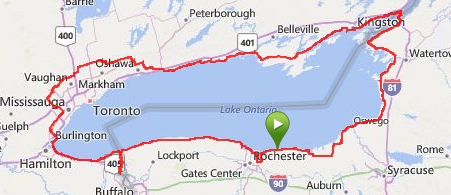
Isn’t this a lovely track of the ride!
Plan the Ride
The basic plan was to ride Day 1 as a series of 200k rides with a planned time of 10 hours for each. That worked out to 15 mph rolling and 1.5 hours stopped every 200k. Days 2 and 3 were planned as 14 mph rolling and 1.5 hours every 200k. Also planned was 7.5 hours off the bike for Sleep 1* and the same for Sleep 2*. This would result in a ride time of 67 hours. From there, I calculated the estimated departure times for each control and each overnight sleep. Such a plan would require laser focus at the controls and efficient use of time. It was very generous in terms of sleep time, so there was built in flexibility there. The 67 hour estimated finish was still leaving an 8 hour cushion on the end of the ride.
My riding partner, Mike, signed off on the plan, knowing that it was subject to change and flexible.
I did not factor in each leg’s conditions (climbing, walking the bridges, etc.)
Leg 11b started 3 hours later than the plan because sleep was important. We got to the hotel about 3 hours late so we decided that a 7 am departure made much more sense than a 4 am departure. Mike and I were efficient and were on the bikes about 5 minutes early. We passed a couple of riders having breakfast at a coffee shop. We passed Jack and Mike C taking their time. We made great time in comfortable temperatures and good roads, ending up at the control some 26 miles from the start hungry and ready for a break. We found a diner after checking in and proceeded to again spend way too much time in the restaurant. It was a big meal and we were concerned that it might impede our progress on the next leg. While eating, other SPP riders pulled in to eat. We didn’t wait for them, but Bryan was able to wolf down his food and join us. (Pretty much on adjusted schedule)
Leg 12 was the most fun of all of the legs of this ride. There were seven cues for 60+ miles of riding. Mike, Bryan and I set a great pace with a light cross/tail wind and soon we caught up to other riders. They joined what they referred to as the SPP train. Each time we collected another rider, we increased the speed. Soon Bryan and I took turns pulling this train at 20-21 mph with other riders tight in our slipstream. The miles passed easy. As long as I was in the lead, my knee didn’t hurt much. After about 10-15 miles of this, riders started sliding off the back, not able to hold the pace. Mike, Bryan, and I found ourselves alone again just as we entered the Apocalyptic Highway. This 4 lane divided highway was built for planned growth between Rochester and Niagara Falls. The growth never happened and the highway has been mostly abandoned. Non commercial traffic is permitted, but we encountered only a few cars every five miles or so. We had our own lane, even though weeds grew through some of the expansion joints. We kept a good pace up. We found a fruit stand with shade about halfway along this leg, and stopped for some strawberries. It was here that Dan and Clint caught us (following our trail of abandoned riders) and we joined together for the rest of the leg. We stopped in Charlotte for lunch and maintained good control discipline. (On adjusted schedule)
Leg 13 was the last leg of the ride. It took us into Rochester, complete with a big climb. In Rochester my knee was giving me a lot of trouble and I caught one light green while others caught it red. I kept my pace and cadence up and rode alone for a few miles. Clint caught up to accompany me and I informed him that I needed to set my own pace based on the speed and cadence that kept my knee from exploding. He accompanied me sometimes from the front, sometimes from the back, often confused about the navigation. Once on Lakeshore Road, I expected the route to flatten out, but there were considerable rollers in the first half. Soon enough, we were pulling into the finish. My official time for the ride was 69:49 which was slightly ahead of the adjusted schedule.
Not bad! The plan called for 67 hours. We lost 3 hours on day 2 mostly because we were dealing with a larger group, trying to keep it together. All the other times, we were pretty much on schedule. We finished less than 3 hours longer than the initial plan.
After last week’s “recovery rides” we are getting back into our routines. This morning we had six of the core SPP riders out on a 70°F morning. It was much darker than it has been. We know we are losing the light in the mornings now until December. We left at a pretty quick pace which gradually increased throughout the ride. By the end of the ride, we were full on riding as fast and hard as we could. At one point, I was gapped by about 150 yards and decided to play catch up. I got within 30 yards, rolling along at 25 mph and watching the small group ahead pull slowly away. Scott later said he saw 32 mph on his bike computer. Yes it was fun. Yes, tomorrow will likely be even faster. July is like that as some of the riders are watching the Tour de France.
I’m still working out the details of my next cycling goal set. It may be related to the upcoming Seagull Century in September. I’m still putting together the details. I like riding with longer range goals in mind.
Yesterday I fixed the front derailleur shifting problem. The front derailleur had been bumped out of kilter (likely as we were loading or unloading the bikes in the trailer for the 1,000k). It was a simple fix and shifting is good now.
Update: 4359 miles on the year so far. At 864 for the month. I would like to have a 1,000 mile month, and I think barring some disaster, it will happen.

 Rev Rider